
Custom printed paper and PET cups
How your own design goes onto the cup: flexo and CMYK offset work, in as many as six inks, what the artwork file has to contain, which parts of the wall stay clear of the design, and how a proof is approved before a run starts.
Custom paper cups are what most buyers are really shopping for, and this page is written for the person who has to order them by the container rather than by the sleeve. The shell is the one object in a takeaway order that a customer picks up and carries down a street, which turns packaging into advertising. What follows sets out how the decoration is produced, what your design file must contain, which parts of the wall take no artwork, what the minimum order is, and what happens between your drawing arriving and a press starting. Printed paper cups are quoted here by the carton and the pallet rather than by the piece, so the figures below are the ones an importer actually books against.
Flexography and the number of inks
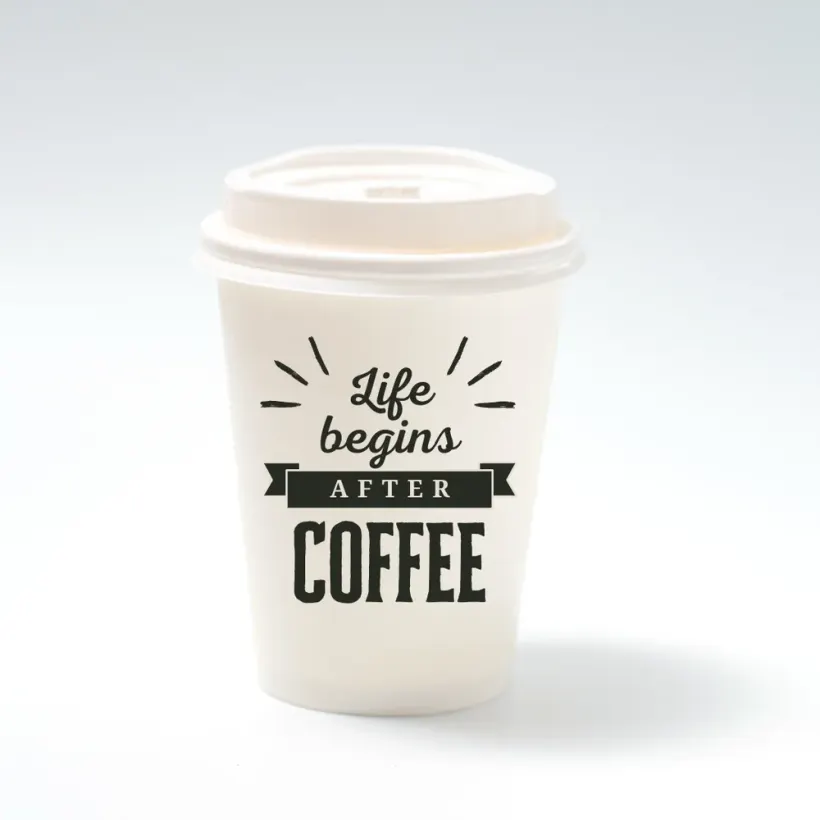
Decoration is applied by flexographic press. Every ink in a design needs a photopolymer plate of its own, and the plates lay their colour onto the flat blank one station after another before the shell is formed, so the number of inks in your artwork is the single figure that governs how much preparation a job carries — and it is the figure we ask for first when we price a run. Up to six are available on the articles that hold a printing specification, among them the single-wall and vending hot sizes and the coated cold shells. The double-wall range is printed in CMYK offset instead, and clear PET runs dry offset in two colours as standard (up to four on request); lids are supplied plain, with the branding carried by the cup. That six-colour ceiling is the practical difference between custom paper cups and a digital short run: the preparation is heavier, and it is done once rather than for every cup that follows it. It is also why branded paper cups earn their place at container volume rather than at sleeve volume: one plate set carries every reorder that keeps the same design.
Two inks or six, and what the press reproduces
A design in two flat inks reaches the press sooner and with less set-up than a six-ink one, simply because fewer plates are cut and fewer stations have to hold register; tell us the ink count with your quantities and the offer separates that one-off preparation from the per-cup price. The process also has preferences. Solid blocks, line work, clean type and defined spot colours reproduce faithfully, while soft photographic shading and long tonal fades do not. If your marque exists only as a photograph, have it rebuilt as vector shapes with named colours first — we say so in writing before any plate is cut, rather than printing something we can already see will not hold.
What a print-ready file has to contain
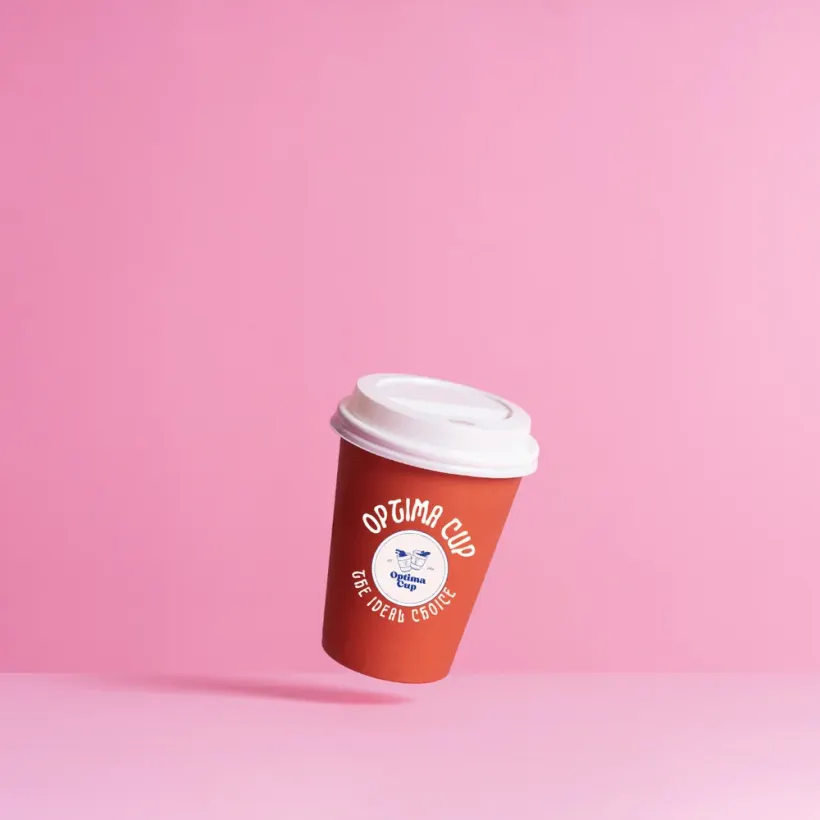
Send vector artwork with every typeface converted to outlines and every colour named rather than described in words. Lay the design on the flat blank of the article you have chosen, at actual size; ask for that drawing and we send it for the exact size, so your studio is not guessing; no two are the same shape. A cup wall is a cone, which means its flat form is an arc and not a rectangle, and a line of type set on a straight baseline in your layout will ride uphill on the finished shell unless it was drawn on the curve to begin with.
Two bands stay outside the design. The strip immediately below the mouth is rolled to form the rim and takes no ink, and a margin at the foot is where the base disc is seamed into the wall. There is a vertical overlap as well, where the two ends of the blank are joined, so a pattern meant to run right around the shell has to be planned across that join. How much room all this leaves changes from article to article: the 8 oz narrows from an 80 mm mouth to a 57 mm base across 87.5 mm of height, while the 12 oz falls from the same mouth to 51 mm across 118 mm. Identical rims, noticeably different panels — and the measured panel for each size you order is stated on the offer, so one artwork can be planned across the whole range.
Proof, approval and the file after the run
Nothing goes on press until you approve a layout. You receive the design positioned on the flattened blank with the measured panel marked around it, and it repays reading as a proof, not a picture: spelling, legal wording, barcodes, the volume marking and the behaviour of the artwork across the join are all settled at this point. Colour is what travels worst on a screen, so quote reference codes for the shades your identity depends on and they are matched at the press instead of guessed from a PDF.
Approved artwork is filed under the article name together with the plates cut for it, at our factory, so nothing has to be rebuilt when you reorder. For a buyer who repeats the same custom paper cups season after season, that filing is the difference between one preparation and four. A repeat purchase then reproduces the earlier run without fresh preparation, which is a practical argument for staying on one size across seasons. Tell us whenever a design has moved, however small the change appears; a revised address line or a redrawn symbol still means a new plate for the ink it sits in. Seasonal versions count as separate artworks and are quoted side by side on one offer.
Custom paper cups against plain stock
Undecorated articles are the faster road. They carry no artwork stage, no plate preparation and no approval loop, which suits a wholesaler moving volume under nobody's name in particular. Printing adds those steps and generally lifts the workable quantity for the article, because a press has to be worth setting up. Custom paper cups carry that extra step because the cup leaves the building in a customer's hand; plain stock never has to. Between the two, the real question is whether your packaging is doing any selling for you: for a coffee chain or a roastery it plainly is; for a bulk water service it may not be.
Buyers arrive at this page with different words for the same order. A café chain asks for printed coffee cups, a packaging wholesaler for branded paper cups under its own house mark, an importer simply for printed paper cups by the container — and on our line all three are one job: your vector artwork, our flexo unit, up to six inks on the cup wall. What separates the enquiries is the ink count and the quantity, not the wording, which is why an offer opens with those two figures.
Custom printed paper and PET cups: what a first order needs
Either way the minimum order is the same for printed and plain, 3 pallets or 60 cartons, and how many cups that is depends on the pack quantity of the size you choose. On clear PET items the minimum is one full truck. On the board items a partial load is also possible: collect the goods from our factory with your own vehicle or a forwarder you appoint, and we can supply 1 or 2 pallets as well — the unit price rises as the pallet count drops. Send the article names, the quantity against each, how many inks the design needs and the country the goods have to reach. The written reply comes back with the printable panel, the ink count, the packing and the schedule for that specification. The delivery term follows the type of load — FCA as standard, EXW on a part load, DAP on a full truck, FOB or CIF by sea — a proforma invoice follows your approval, and once the transfer lands the run goes into the production schedule. If the drawing is not finished yet, write anyway: we send the measured panels for the sizes you are considering first, and the custom paper cups are designed against real dimensions rather than a guess. A first order for printed coffee cups usually covers two or three sizes at once: one approval and one set of plates then serve the whole counter.
Tell us the quantity, we come back with a price
Pick the sizes you need and send them in one message — you get a quotation, not a list of questions.